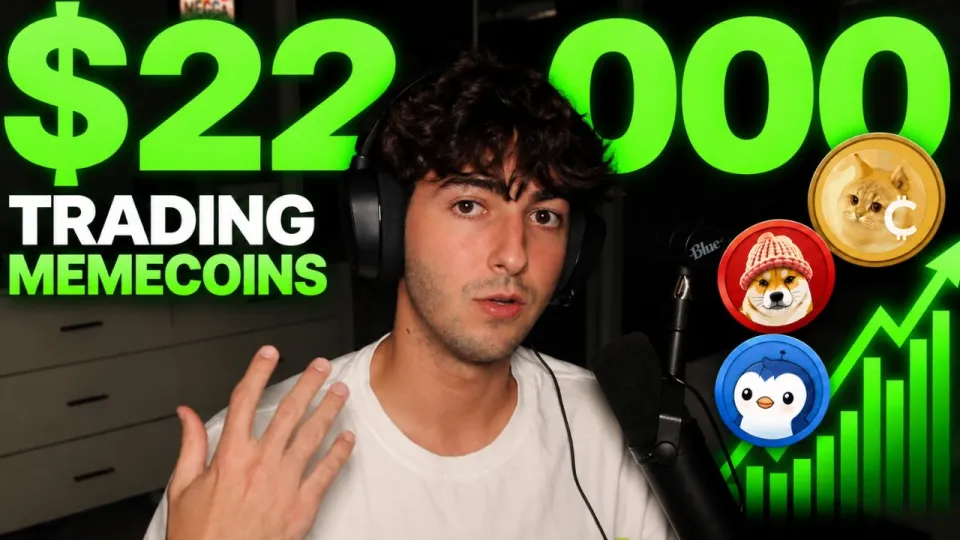
Meme Coin Trading Guide to a $22,000 Single Trade
Need articles like this for your video? They help promote it on YouTube and Google — order them in the Telegram bot @sat_sit_bot. Articles with your video embedded are written and posted by the bot itself — on popular topical sites (no ads). Try it free: 50 articles on us.
· based on the channel Megga
Key takeaways
- Megga reports a single meme coin trade that produced roughly $22,000 in profit, documented in a full walkthrough guide.
- The trade relied on early entry into a low-cap token, with the exit scaled out into incoming volume rather than sold in one order.
- A free beginner trading guide is offered through Whop, and execution is shown on the Padre terminal.
- Meme coin outcomes depend heavily on liquidity depth and on who else is trading the same token at the same time.
- Position sizing and a predefined invalidation level are what separate a repeatable process from a one-off win.
A meme coin is a crypto token whose value comes almost entirely from community attention and narrative rather than from revenue, cash flow or a product. In the trade breakdown published by Megga, a single meme coin position reportedly turned into about $22,000 in profit, and the full walkthrough is built around the mechanics that made that outcome possible: early entry, a defined exit plan and strict position sizing. The free beginner trading guide behind the strategy is available at the Whop beginner course, which covers the basics before any real capital is deployed.
What the $22,000 meme coin trade actually involved
The result came from one position, not from a portfolio of coins, and the guide frames it as a repeatable process rather than a lottery ticket. Meme coin trading on launchpads and decentralized exchanges moves fast: a token can be minutes old, liquidity can be a few thousand dollars, and the price chart is often a straight vertical line followed by an equally steep drawdown. In that environment the edge is rarely the token itself; it is the sequence of decisions around it.
The walkthrough focuses on three practical elements. First, screening: finding a token early enough that the market cap is still small and the holder count is growing. Second, execution: buying through a terminal that shows liquidity, holder distribution and recent trades in one view, which is why the video points to the Padre trading terminal. Third, exiting: selling into strength in tranches instead of trying to catch the exact top. A $22,000 result on a single trade implies both a meaningful position size and a large percentage move, and the guide is explicit that the second condition cannot be assumed in advance.
How to find a meme coin before the crowd
Early discovery is the whole game in low-cap meme coins, because by the time a token trends on social feeds the easy part of the move is usually gone. A workable screening routine looks like this:
- Track launches on the chains and launchpads where volume is currently concentrated, rather than spreading attention across every ecosystem.
- Filter by liquidity and holder count, not by price. A token with thin liquidity and a handful of wallets is a trap regardless of its chart.
- Check the contract for mint authority, freeze authority and concentrated ownership before buying a single unit.
- Look at the wallet distribution: if the top ten holders control most of the supply, the exit door is narrower than it appears.
- Confirm that trading volume is coming from many wallets rather than a small cluster of addresses moving the same funds.
The video's terminal setup is designed to surface exactly these numbers quickly, because in meme coin trading a two-minute delay can mean buying at double the price or missing the move entirely.
Position sizing and risk rules for a single meme coin bet
A single trade producing five figures only makes sense if the amount risked was small relative to the account. The standard approach is to risk a fixed percentage of capital per idea, typically 1–3%, and to size the position from the invalidation level rather than from conviction. If the plan is to exit at a 40% drawdown, a $1,000 risk budget supports a $2,500 position; a $10,000 position on the same budget would require a 10% stop, which meme coin volatility will hit almost immediately.
Three rules keep a single meme coin trade from becoming an account-ending event:
- Decide the maximum loss before the buy order, and treat it as the cost of the ticket.
- Scale out in tranches: recover the initial capital on the first partial sell, then let the remainder run.
- Never add to a losing meme coin position; averaging down on an illiquid token usually means doubling exposure to a chart that has already broken.
Slippage belongs in the same calculation. On a token with modest liquidity, a large market sell can move the price several percent against you, so the realistic exit is worse than the quoted one.
Typical doubts about meme coin profits
The most common scepticism around results like this is that they are not reproducible without an audience. A trader with a large following can post a token and watch demand arrive; someone without that reach is trading a different market. That criticism is fair as a caveat, and it changes the lesson: the useful part of the breakdown is the process, not the number.
Other recurring questions concern the size of the starting capital, whether smaller accounts can run the same playbook, and how to trade adjacent formats such as coins launched directly from social posts, profile coins and community coins. Those formats differ mainly in how the supply is distributed and who controls the narrative, and each needs its own checklist before entry. The honest framing is that a five-figure outcome from one trade is an outlier; a trader who repeats the process will see many small losses and occasional large wins, and the wins only compound if the losses stay small.
Tools and links used in the breakdown
Every resource referenced in the trade walkthrough is listed below, in the order it appears.
- Free beginner trading guide: https://whop.com/wiredd
- Trading terminal used for execution: https://trade.padre.gg/rk/megga
- Live streams: http://www.twitch.tv/megga
- Short-form clips: https://www.tiktok.com/@meggafaze
- Trade commentary and updates: https://twitter.com/megga
Conclusion
A $22,000 meme coin trade is the visible output of a process that is mostly about what happens before and after the buy: screening for liquidity and holder quality, sizing the position so a loss is survivable, and selling into demand rather than hoping for a higher price. Megga's breakdown is useful precisely because it shows that sequence instead of only the profit number. Anyone starting out should work through the fundamentals first via the free beginner guide on Whop, then trade small until the routine is automatic. Treat the five-figure result as a possible outcome of a disciplined process, never as the expectation for the next trade.
Questions & answers
How much capital do you need to make $22,000 from one meme coin trade?
There is no fixed amount, because the result depends on the percentage move captured and the position size. A large profit on a single trade usually means a meaningful position relative to the account, which also means a meaningful loss if the trade fails. Most traders size positions so that a full invalidation costs 1–3% of capital, and accept that five-figure outcomes are rare outliers rather than a plan.
Can a small account replicate the same meme coin strategy?
The mechanics are identical, but the arithmetic is not. A $500 account cannot produce a five-figure profit without extreme risk that would likely wipe it out first. Smaller accounts should focus on repeating the process — screening, sizing, scaling out — and let the results compound, rather than chasing the same dollar figure.
What is the biggest risk in trading low-cap meme coins?
Liquidity. A token with a few thousand dollars of liquidity cannot absorb a large sell order without the price collapsing, so the quoted chart price is not the price you will actually receive. Concentrated holder distribution and contracts with mint or freeze authority add a second layer of risk, which is why both should be checked before any buy.
Does having a large following make meme coin profits easier?
Yes, and that is a legitimate caveat. A trader with an audience can generate attention for a token, which is a different market condition from trading anonymously. The transferable part of any such breakdown is the process — entry criteria, position sizing, exit plan — not the assumption that the same demand will appear for someone else's trade.
Source: How I Made $22,000 in a SINGLE Memecoin Trade (FULL GUIDE) · Markdown version